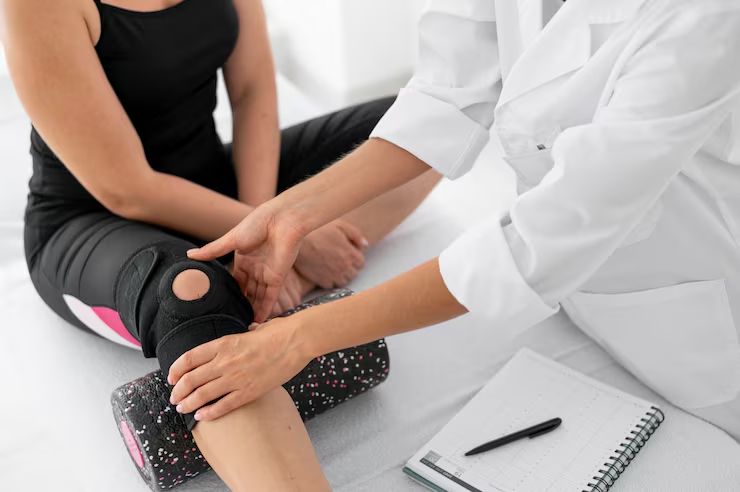
A diagnosis-led return-to-activity plan for training, competition, and repetitive-load injuries. From an acute incident to a recurring training problem, care starts by identifying the injured tissue and the demands it must tolerate.
An injury can interrupt training and make returning to your sport feel uncertain. Assessment identifies the injured structures and the demands of your activity so that treatment and rehabilitation have clear functional goals.
Dr. Adarsh Krishna K Bhat, Consultant Orthopaedic, Robotic, and Conventional Joint Replacement Surgeon (MBBS, MS Ortho - Gold Medallist, DNB, MNAMS, MCh Trauma & Ortho - Edinburgh, UK), offers consultations in Bangalore. The sports consultation relates examination findings to the patient's training environment, competition requirements, and history of recurring problems.
When Should You Consider Sports Injury Treatment?
An injury that changes movement, interrupts training, or repeatedly returns should be assessed before loading is increased.
Training-linked pain: Pain linked to a particular training load.
Sudden functional loss: Loss of function after a sporting incident.
Recurring setback: Repeated injury when resuming the same activity.
Performance asymmetry: One limb cannot absorb force, accelerate, or change direction with the control needed for the intended activity.
Common Conditions Treated
Acute ligament injury: A sudden sporting event disrupts a stabilizing structure.
Muscle or tendon overload: Repeated demand exceeds the tissue's current capacity.
Activity-related joint injury: Cartilage or meniscal damage can limit training tolerance.
Bone stress injury: Repetitive loading can injure bone without a single accident and may require stricter protection than a muscle overload problem.
Understanding Sports Injury Treatment
Sports injury care addresses injured tissue as well as the movement and training factors that contributed to the problem. Muscle, tendon, ligament, and cartilage injuries need different loading strategies. Assessment separates structural damage from overload and compares current capacity with actual sporting demands. The plan should support tissue recovery without assuming that every injury requires surgery or complete rest.
Advanced Sports Injury Treatment Options We Offer
01
Sport-specific rehabilitation
Builds tissue capacity and addresses technique or conditioning deficits. The programme should specify which activities remain acceptable and how workload will be progressed. Recovery planning includes strength and movement control rather than relying only on stretching or passive treatments.
02
Selective structural surgery
May be considered for instability or injuries unsuitable for conservative care. A structural operation is considered only after clarifying the lesion and its consequences for activity. The rehabilitation burden and the possibility of modifying participation should form part of informed decision-making.
Your Step-by-Step Patient Journey
1
Assessment and planning
Injury mechanism, recent training changes, movement quality, and appropriate targeted imaging guide the working diagnosis. The clinician asks about the sequence of symptoms, equipment, playing surface, rest, and recent workload changes. These details help distinguish an isolated incident from a recurring mismatch between demand and capacity.
2
Procedure or clinical management
Care is directed at the diagnosed structure. When an operation is required, repair or reconstruction is linked to a rehabilitation plan that accounts for the athlete's position, training exposure, and required movements. Non-operative management may include temporary load restrictions with specific exercise targets; an operation is only one possible branch of the care pathway.
3
Rehabilitation and follow-up
Progression moves from basic function to sport drills with readiness checks before unrestricted participation. The demands of practice and competition are separated so that progress can be tested under increasingly realistic conditions. A flare after loading is useful feedback and should prompt review of the progression.
Benefits of Modern Sports Injury Treatment
Load understanding: Assessment considers how training quantity and intensity relate to symptoms.
Capacity rebuilding: Recovery aims to restore the abilities needed for the specific activity.
Return planning: Progression can distinguish general fitness from readiness for competition.
Recurrence awareness: Recognizing the conditions surrounding previous setbacks can help shape a more sustainable approach to future participation.
Note on Risks & Alternatives
Returning before adequate tissue healing and conditioning increases reinjury risk even after pain settles. Some injuries worsen if training continues despite warning symptoms, and surgery has its own risks when indicated. Activity modification and rehabilitation are often suitable alternatives. Clearance must reflect the diagnosed tissue and functional demands; absence of pain alone cannot establish readiness for competition.
Why Choose Dr. Adarsh Krishna K Bhat for Your Sports Injury Treatment?
Personalized Treatment Planning: Your symptoms, examination findings, daily activities, and rehabilitation needs guide the consultation.
Informed Treatment Decisions: Discuss suitable treatment choices, alternatives, and their limitations before deciding on your care.
Frequently Asked Questions
01. Can another body region be trained during recovery?
Often, provided the exercise does not stress the healing injury or conflict with its restrictions. Cross-training should be selected around the diagnosed structure; an exercise that feels easy aerobically may still place substantial load across the injured tissue.
02. Should a pain-free warm-up be treated as clearance to compete?
No. Symptoms during or after full training, tissue capacity, and the injury diagnosis also matter. A warm-up can temporarily change symptoms without demonstrating tolerance of contact, repeated sprinting, or the fatigue experienced later in a match.
03. Can a sudden increase in training cause problems without a single accident?
Yes. A change in volume, intensity, or recovery can contribute to an overload injury. Discuss the size and timing of workload changes, including extra sessions outside formal training that may otherwise be overlooked in the history.
04. Is match fitness the same as being able to jog?
Competition may demand sprinting, contact, fatigue resistance, and rapid decisions that a short jog does not test. A staged return can test these demands separately, allowing weaknesses to be addressed before the athlete faces the unpredictability of competition.
05. Why discuss previous injuries during a new sports consultation?
Earlier injuries, residual weakness, and previous recovery patterns can influence the current assessment and training plan. Describing what caused earlier setbacks can reveal practical barriers to rehabilitation that would not be apparent from a scan of the current injury.
Personalized orthopaedic care
Take the First Step Toward Pain-Free Mobility
Schedule an evaluation with Dr. Adarsh Krishna K Bhat to discuss sports injury treatment. Bring your current imaging and diagnostic reports to review treatment options suited to your symptoms and daily activities.
Disclaimer: This sports injury treatment information is for patient education. Individual recommendations require clinical assessment and discussion of the relevant alternatives and risks.
Five-star patient reviews
Patient Stories & Recovery Experiences
Selected five-star feedback about Dr. Adarsh Krishna K Bhat's orthopaedic care, consultations, and surgery guidance.
”
M
Madhu Shree
Patient review
I am truly grateful to Dr. Adarsh for the care and guidance he has provided to my family over the years. When my father met with an accident and had to undergo surgery in our hometown, Dr. Adarsh guided us throughout the process over phone calls. Although he was not the doctor in charge of the surgery at that time, he was always available whenever we had doubts or concerns. Even after the surgery, he continued to guide us through the post-operative recovery and consultations, and his advice played a very important role in helping my father get back on his feet and walk again.
Orthopaedic Consultation & Surgery Guidance
”
A
Anandu Harikumar
Patient review
Dr Adarsh is an exceptional orthopaedic doctor. What I really appreciate is how calm and approachable he is with patients. He listens patiently, explains everything clearly, and makes you feel comfortable throughout the consultation. His friendly nature and genuine care for his patients really stand out. Highly recommended.
Orthopaedic Consultation
”
T
Thanu Shree
Patient review
I had a very good experience with the Dr. Adarsh Bhat. My bone chip had broken, and I needed surgery, which was performed by him. He was extremely kind, supportive, and attentive throughout the process. He personally followed up with me and made sure I was comfortable and recovering well. The entire procedure was very smooth, and I felt I was in safe hands throughout. I'm truly grateful for his care and would definitely recommend him to anyone looking for a skilled and compassionate doctor.
Bone Fracture Surgery
”
c
ch pavan
Patient review
We are extremely grateful for the excellent care my mother received throughout her knee replacement surgery. From the initial consultation to the post-surgery recovery, the entire process was smooth, well-organized, and reassuring.
A special thanks to Dr. Adarsh for his expertise, professionalism, and compassionate approach. His guidance and confidence gave us complete peace of mind throughout the journey.
Knee Replacement Surgery
”
R
Rekha Parna
Patient review
Dr. Adarsh is a great orthopedic surgeon. Kind, patient, knowledgeable and helpful. He handled my dad’s knee surgery for both knees. We were all quite anxious as my dad was suffering from knee pain on left leg for many years and tried multiple things before agreeing for surgery. However it was quite late that his right knee also was affected equally. So, only option was to operate both.