Orthopaedic AssessmentFragment Mapping

Complex Fracture Fixation Surgery in Bangalore

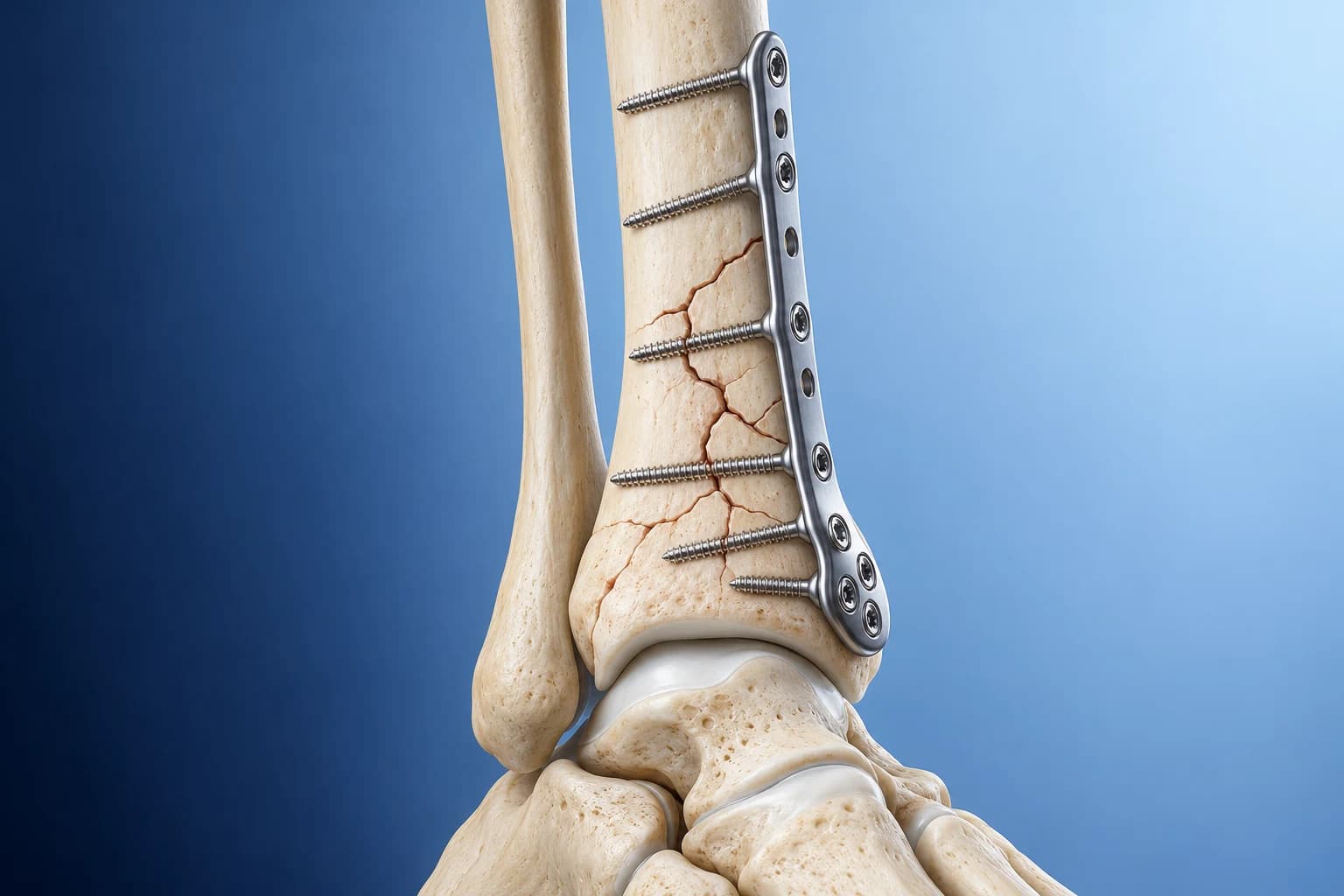
Illustration of a fragmented distal tibial fracture supported by a fixation plate and screws

When a fracture is fragmented or healing has stalled, another routine fixation may not address the cause. Reconstructive assessment examines bone support, infection, soft tissues, and the practical sequence needed for recovery.

Fragment MappingAssessment
Reconstructive FixationPlanning focus
Bone BiologyTreatment consideration
Union MonitoringFollow-up priority

Complex fracture assessment

Clinical focus

Bone fragment reconstruction

Clinical focus

Soft-tissue and wound care

Clinical focus

Bone alignment and healing

Clinical focus

Clinical Anatomy & Treatment Guidance

Complex Fracture Fixation Surgery

Complex Fracture Fixation Surgery

A complicated fracture can affect more than the broken bone, with swelling and soft-tissue injury adding to recovery needs. Planning brings these factors together to guide stabilization, rehabilitation, and follow-up.

Dr. Adarsh Krishna K Bhat, Consultant Orthopaedic, Robotic, and Conventional Joint Replacement Surgeon (MBBS, MS Ortho - Gold Medallist, DNB, MNAMS, MCh Trauma & Ortho - Edinburgh, UK), offers consultations in Bangalore. Complex-fracture planning explains how the proposed reconstruction addresses the particular obstacles to stability, union, and useful limb function.

When Should You Consider Complex Fracture Fixation Surgery?

A specialist reconstruction review is useful when fragmentation, infection, deformity, or previous failure makes the route to healing unclear.

  • Joint-surface disruption: Fracture fragments extending into a major joint.
  • Persistent fracture motion: Ongoing painful movement at a poorly healing fracture.
  • Failed earlier fixation: Implant failure or deformity after previous fixation.
  • Disturbed limb mechanics: A healed or partly healed injury leaves significant angulation, rotation, or shortening that interferes with ordinary use.

Common Conditions Treated

  • Articular comminution: Several fragments disrupt the joint's load-bearing surface.
  • Established non-union: A fracture lacks satisfactory progression toward mechanical and biological healing.
  • Infected fixation: An implant-related infection complicates both stability and bone reconstruction.
  • Symptomatic malunion: Bone has consolidated in a position that may require corrective reconstruction after clinical evaluation.

Understanding Complex Fracture Fixation Surgery

A fragmented fracture or failed earlier fixation may need reconstruction that addresses both structural support and the conditions for bone healing. Planning examines joint-surface damage, alignment, bone gaps, infection, and soft-tissue coverage. Changing a plate or adding graft alone may be insufficient if another unresolved problem continues to prevent a stable, biologically supported repair.

Advanced Complex Fracture Fixation Surgery Options We Offer

01

Revision stabilization

Improves alignment and fixation where the current construct is inadequate. Removal of old hardware is considered alongside the remaining bone and the cause of failure, rather than assuming a stronger plate alone will solve it.

02

Biological reconstruction

Grafting or staged infection treatment may be added when indicated. The source and purpose of any graft, as well as the need for wound coverage or infection control, should be explained before reconstructive surgery.

Your Step-by-Step Patient Journey

  1. 1

    Assessment and planning

    Current radiographs, CT mapping, earlier surgical records, and indicated infection tests establish the reconstruction requirements. The review also identifies whether compromised skin or a persistent wound needs coordinated coverage before the planned bone reconstruction can be protected. Vascular compromise can change the reconstructive sequence.

  2. 2

    Procedure or clinical management

    The reconstruction may combine removal of failed implants, restoration of alignment, revised fixation, and treatment of bone or soft-tissue deficits. Infection can change the order and timing of these stages. The timing of each stage follows the biological and soft-tissue findings rather than a predetermined sequence for all patients.

  3. 3

    Rehabilitation and follow-up

    Union is assessed over successive visits. Weight-bearing may remain limited while bone defects and reconstructed surfaces gain strength. Progress is judged through symptoms, examination, and interval images; extending protection may be necessary even when the external wound appears settled. Persistent drainage requires prompt clinical review.

Benefits of Modern Complex Fracture Fixation Surgery

  • Defect-specific support: Fixation can be adapted to the remaining fragments and bone gaps.
  • Biological attention: Healing obstacles are reviewed alongside mechanical weaknesses.
  • Functional reconstruction: Joint congruity, rotation, and limb length are considered together.
  • Staged priorities: Separating infection control, coverage, and definitive bone support can make a complex care pathway more understandable.

Note on Risks & Alternatives

Recurrent infection, further non-union, loss of fixation, and residual deformity can necessitate another procedure. An extensive injury may not regain its previous motion or strength, and salvage can require repeated procedures. Continued observation or a different reconstructive option may be reasonable when the likely benefit does not justify the surgical burden.

Why Choose Dr. Adarsh Krishna K Bhat for Your Complex Fracture Fixation Surgery?

  • Distinguished Academic & Clinical Pedigree: MBBS, MS Ortho - Gold Medallist, DNB, MNAMS, and MCh Trauma & Ortho - Edinburgh, UK.
  • Personalized Treatment Planning: Your symptoms, examination findings, daily activities, and rehabilitation needs guide the consultation.
  • Informed Treatment Decisions: Discuss suitable treatment choices, alternatives, and their limitations before deciding on your care.

Frequently Asked Questions

01. Is slow fracture healing the same as non-union?

Not necessarily. The distinction depends on healing progression, imaging, symptoms, and the original injury environment, as well as elapsed time. Bring earlier films for comparison; a single current image or a calendar date cannot fully describe whether union is continuing.

02. Why can CT be useful for a fragmented joint fracture?

Cross-sectional images can clarify fragment geometry and assist planning where ordinary radiographs are difficult to interpret. The additional views are useful when they answer a planning question, rather than as a routine substitute for reviewing the original radiographs.

03. Can a bone graft replace the need for stable fixation?

A graft addresses biological or structural needs, but inadequate stability may still prevent satisfactory union. Mechanical stability and biology interact, so the reconstructive discussion should explain the problem that each proposed addition is intended to solve.

04. Will an infected non-union always be reconstructed in one sitting?

Not necessarily. Infection clearance, tissue coverage, and skeletal support may need separate planned stages. Ask how temporary stabilization and wound management fit between stages, because the period before definitive reconstruction still needs a clear care plan.

05. Why does rotational alignment matter after a long-bone injury?

A healed bone in an abnormal rotational position can alter limb mechanics even when its length looks acceptable. The functional significance depends on the bone involved and the size and direction of the deformity, not solely the appearance of one image.

Personalized orthopaedic care

Take the First Step Toward Pain-Free Mobility

Schedule an evaluation with Dr. Adarsh Krishna K Bhat to discuss complex fracture fixation surgery. Bring your current imaging and diagnostic reports to review treatment options suited to your symptoms and daily activities.

Disclaimer: This complex fracture fixation surgery information is for patient education. Individual recommendations require clinical assessment and discussion of the relevant alternatives and risks.

Five-star patient reviews

Patient Stories & Recovery Experiences

Selected five-star feedback about Dr. Adarsh Krishna K Bhat's orthopaedic care, consultations, and surgery guidance.

”
M

Madhu Shree

Patient review

I am truly grateful to Dr. Adarsh for the care and guidance he has provided to my family over the years. When my father met with an accident and had to undergo surgery in our hometown, Dr. Adarsh guided us throughout the process over phone calls. Although he was not the doctor in charge of the surgery at that time, he was always available whenever we had doubts or concerns. Even after the surgery, he continued to guide us through the post-operative recovery and consultations, and his advice played a very important role in helping my father get back on his feet and walk again.

Orthopaedic Consultation & Surgery Guidance
”
A

Anandu Harikumar

Patient review

Dr Adarsh is an exceptional orthopaedic doctor. What I really appreciate is how calm and approachable he is with patients. He listens patiently, explains everything clearly, and makes you feel comfortable throughout the consultation. His friendly nature and genuine care for his patients really stand out. Highly recommended.

Orthopaedic Consultation
”
T

Thanu Shree

Patient review

I had a very good experience with the Dr. Adarsh Bhat. My bone chip had broken, and I needed surgery, which was performed by him. He was extremely kind, supportive, and attentive throughout the process. He personally followed up with me and made sure I was comfortable and recovering well. The entire procedure was very smooth, and I felt I was in safe hands throughout. I'm truly grateful for his care and would definitely recommend him to anyone looking for a skilled and compassionate doctor.

Bone Fracture Surgery
”
c

ch pavan

Patient review

We are extremely grateful for the excellent care my mother received throughout her knee replacement surgery. From the initial consultation to the post-surgery recovery, the entire process was smooth, well-organized, and reassuring. A special thanks to Dr. Adarsh for his expertise, professionalism, and compassionate approach. His guidance and confidence gave us complete peace of mind throughout the journey.

Knee Replacement Surgery
”
R

Rekha Parna

Patient review

Dr. Adarsh is a great orthopedic surgeon. Kind, patient, knowledgeable and helpful. He handled my dad’s knee surgery for both knees. We were all quite anxious as my dad was suffering from knee pain on left leg for many years and tried multiple things before agreeing for surgery. However it was quite late that his right knee also was affected equally. So, only option was to operate both.

Bilateral Knee Surgery
Swipe or use arrows to explore